
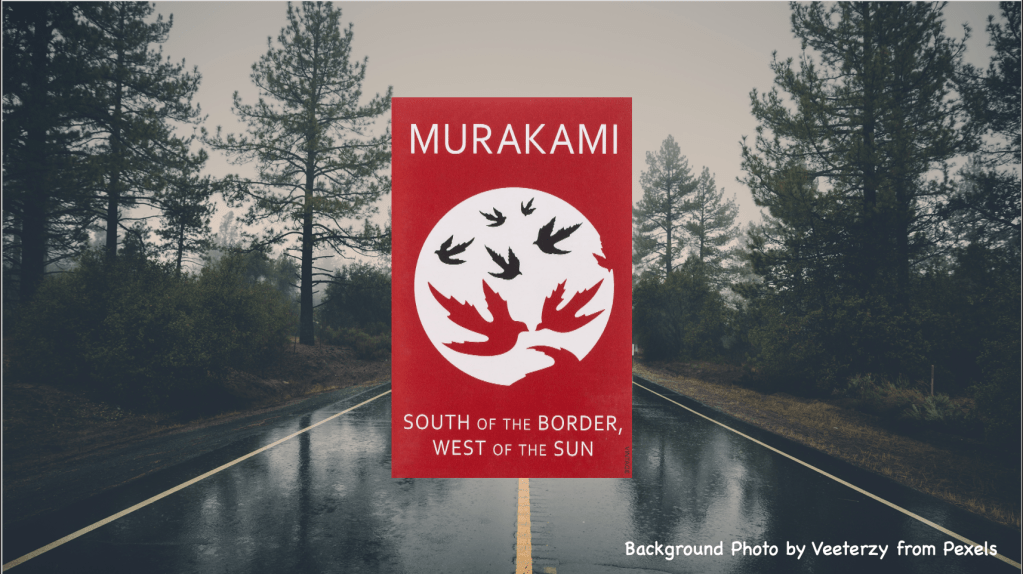
“Sometimes when I look at you, I feel I’m gazing at a distant star. It’s dazzling, but the light is from tens of thousands of years ago. Maybe the star doesn’t even exist any more. Yet sometimes that light seems more real to me than anything.”
South of the Border, West of the Sun by Haruki Murakami
This article has spoiled in some parts of the story due to the analysis.
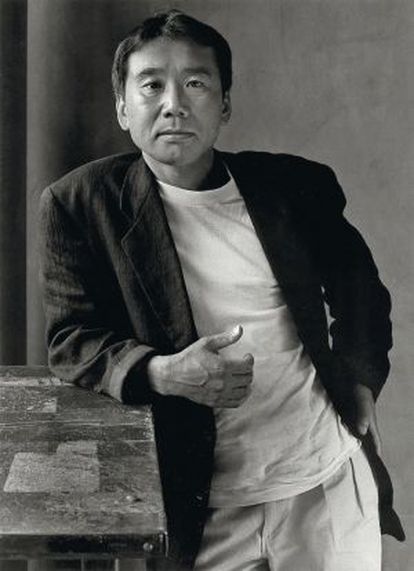
Haruki Murakami was born in 1949. He is a Japanese author who grew up in Kobe and then moved to Tokyo. Murakami opened a small jazz bar after college. He and his wife ran this jazz bar for 7 years.
Hear the Wind Sing was his debut novel which in 1979, it won the Gunzou Literature Prize for budding writer. Then, he released two sequels; Pinball, 1973 and A Wild Sheep Chase, in which became The Trilogy of the Rat (Murakami, n.d, para. 1-2).
Murakami wrote many novels, short stories, including nonfiction, and one of his works is South of the Border, West of the Sun.
South of the Border, West of the Sun is a story of Hajime, a single child, who had a childhood friend named Shimamoto, a girl with a lame leg. Shimamoto was also a single child in the family as the same as Hajime. Both of them had to separate from each other from attending different junior high schools. Unsurprisingly, the connection between them was lost. However, Shimamoto reappeared again on a rainy day while Hajime ran a jazz bar with his wife. Hajime had to choose between his wife, his children, and Shimamoto, a woman that has always been lingered in his heart.
I was so lucky to read this book while there was pouring rain outside of my house. South of the Border, West of the Sun was the first book from Haruki Murakami that I read. After finishing this book, I could not find the appropriate words for my emotions. This book is so amazing. I love it, to be frank. I could not put it down the moment I read it.
“Have I ever felt like I miss someone like Hajime?” is the question right in my head after reading this story. In my own perspective, I believe that the book shows us what it would be like when we thought that replacing someone or something with another could fulfil the void in us. However, sometimes it did not. Look at the protagonist, Hajime. he had the inability to move on. He stuck in the past. He always thought of Shimamoto, but he still tried to move on and on with another woman because he thought that those could fulfilled the void in him which in fact, he was wrong. This book taught us to accept our past. No one could change it. We just have to live with it, and learn not to make those mistakes happen in our lives again.
I believe that the female characters in the story are used as the medium. Shimamoto has never ever come back. It is all in Hajime’s imagination. The reason I believe this is because of Shimamoto’s leg. Personally, I believe that leg has to be portrayed in order to show something. In the second half of the story, Shimamoto did not have a lame leg anymore when she reappeared, and Hajime did not know any details about her at all. Why? Because it happened only in Hajime’s imagination. She was something that Hajime clung to, and the scene in the car that she had to take the pill, and the description about her portrayed as if she was dying. It meant something. She was dying in Hajime’s own mind, and the pill and the water that at that time, the source of water came from the snow. Hajime had to melt it in his mouth in order to make Shimamoto had the water to take the pill. Water symbolised life. Hajime’s psyche makes Shimamoto alive.
Moreover, Izumi in the last part of the story was portrayed as the thing that reminded Hajime not to make those mistakes again in his life. He knew how much he destroyed Izumi in the past, and it might happen again with his wife this time if he chose Shimamoto over her. He had everything in his middle-aged man, and he should focus on the present time to have a better future with his own family.
This is my own interpretation. Everyone could have their own perspectives about this story. Some people might think that Shimamoto is real, and this is the charm of Haruki Murakami’s writing. His works are open. It allows us to think further and interpret the work freely.
I would never see her again, except in memory. She was here, and now she’s gone. There is no middle ground. Probably is a word you may find south of the border. But never, ever west of the sun.
South of the Border, West of the Sun by Haruki Murakami
Reference:
Author. Haruki Murakami. (n.d.). Retrieved from https://www.harukimurakami.com/author.
 NAPATSORN TREESAP
Leave a comment